Burj Khalifa is 2.17× as tall as the Empire State Building by architectural height. Dubai’s spire reaches 828 m (2,717 ft). New York’s original crown reaches 381 m (1,250 ft). Compare the very highest point visible on each skyline and the answer changes to 1.87×. The tip in Dubai reaches 829.8 m, while the broadcast antenna in Manhattan brings the Empire State Building to 443.2 m.
Open Burj Khalifa and the Empire State Building together at 1:1 in the 3D Lab. Trace the occupied-floor and observation-deck marks to see how far a visitor could go.
How two Empire State Buildings stack up
Imagine lifting a second Empire State Building onto the roof of the first. Allow 381 m for each, including the original crown. Together they reach 762 m. That leaves a gap of 66 m between the upper crown and the tip of Burj Khalifa’s spire.
Repeat the exercise with the antenna on each copy. The two tips now add up to 886.4 m and clear the Dubai tip by 56.6 m. Changing the endpoint adds 62.2 m to each New York building but only 1.8 m to the Dubai tower. That uneven change is enough to move the answer from just over twice the height to just under twice the height.
| What you measure | Burj Khalifa | Empire State Building |
|---|---|---|
| Architectural top | 828 m / 2,717 ft | 381 m / 1,250 ft |
| Physical tip | 829.8 m / about 2,722 ft | 443.2 m / 1,454 ft |
| Highest occupied floor, current CTBUH profile | 584.5 m / 1,918 ft | 373.1 m / 1,224 ft |
| Observation deck compared here | Level 148, SKY, 555.7 m | 102nd floor, 373.1 m |
| Floors above ground | 163 | 102 |
The Dubai tip converts to 2,722.44 ft at exactly 0.3048 m per foot. The Skyscraper Center prints 2,723 ft for the same tip. The ratios above use the metric measurements before rounding.
Why the spire counts and the broadcast antenna gets a separate height
CTBUH measures upward from the lowest significant open-air pedestrian entrance. Picture a surveyor starting at a public door on a sloping street. A basement loading ramp could be lower and the pavement across the block could be higher. Using a defined entrance lets different surveyors start the tape at the same place.
At the other end of the tape, the architectural rule includes the spire that forms part of the design. Burj Khalifa narrows into a permanent steel spire. An observer can follow the building’s stepped outline almost all the way to the physical tip. The Empire State Building had its familiar tapering crown when it opened in 1931. The big broadcast antenna came later. The owner’s history records the installation of a new television antenna in the 1950s to accommodate more stations.
A broadcaster can replace equipment when technology changes. The antenna still matters to someone looking out of an airplane or drawing the skyline, so the tip measurement includes it. The separate architectural figure lets a historian compare today’s Empire State Building with its 1931 design. The distinction also explains why the familiar 1,454 ft New York landmark appears in architectural rankings with a height of 1,250 ft.
What supports two very different silhouettes?
Look down from above Burj Khalifa and its three wings make a Y. The architects and structural engineers at Skidmore, Owings & Merrill (SOM) arranged reinforced concrete walls around a central six-sided core. Each wing braces the others. A force acting on one wing meets a structure that extends in two other directions. As the tower climbs, successive wings step back at different heights. Wind passing a wide lower tier encounters a different shape higher up, which helps break up the repeating wind forces that can set a tall tower swaying.
On Fifth Avenue, Shreve, Lamb & Harmon designed the Empire State Building around a riveted steel frame. Its setbacks are easy to pick out from street level. A wide base fills much of a city block, rows of windows run up the narrower office shaft, and the small upper floors step in again toward the crown. Steel erection could advance above the crews fitting out the floors below. The owner records a construction run of 410 days in 1930–31. Visitors arriving at the opening on May 1, 1931, saw the original outline well before the later antenna altered its peak.
Where the elevator ride ends
The floor count gives Dubai 61 additional above-ground floors, about 60 percent more than New York. Architectural height gives Dubai about 117 percent more height. You can see where some of the difference goes by tracing the part of each outline above the last occupied floor. In New York, the stretch between 373.1 m and the 381 m architectural top measures only 7.9 m. In Dubai the corresponding stretch from 584.5 m to 828 m exceeds 240 m. Those final meters add a great deal to the skyline without supplying another stack of apartments.
An earlier version of the Dubai building profile listed 585.4 m for the highest occupied floor. The current Skyscraper Center entry lists 584.5 m. Either puts that floor close to 585 m. For an elevator passenger the more useful number is the height of the chosen stop. The Burj has separate destinations for hotel guests, residents, office workers and sightseers. Its elevator count includes service cars. New York’s operator counts 73 Otis elevators in its building, a reminder of how many different trips a tower handles below the public observatory.
For a visitor-to-visitor comparison, choose the SKY deck on Dubai’s level 148, roughly 555 m up, and the enclosed 102nd-floor observatory in New York, about 373 m up. Take the published deck measurements to a decimal place and the Dubai visitor stands 182.6 m higher above the local entrance. Put New York’s entire building beside that deck and the antenna would end 112.5 m below the Dubai visitor’s shoes.
Read the skyline with two familiar landmarks
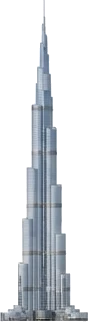 Burj Khalifa828 m to the architectural spire
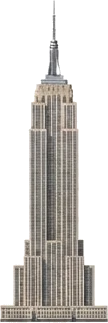 Empire State Building443.2 m including antenna
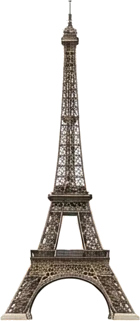 Eiffel Tower330 m including antenna
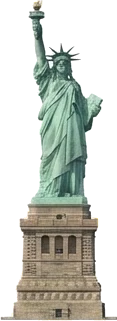 Statue of Liberty93 m with pedestal
In Paris the Eiffel Tower reaches 330 m with its antenna. Imagine standing on the Empire State Building’s upper observation deck and looking level across to an Eiffel Tower set on the same street. Its tip would be 43.1 m below your feet. At ground level on Liberty Island, the distance from the base to the Statue of Liberty’s torch is about 93 m. Four of those heights make 372 m, barely a meter short of the Manhattan observatory. The pedestal accounts for a substantial part of that 93 m each time you stack a copy.
The Eiffel Tower also makes a convenient ruler for checking an illustration. Two copies reach 660 m. They clear Dubai’s highest occupied floor by 75.5 m yet stop 168 m below its architectural top. A single copy beside Manhattan falls 51 m short of the architectural crown and 113.2 m short of the broadcast tip. All four distances fit on the same drawing. On a poster that crops each tower to fill its own panel, the tops can appear level even when the captions give the correct numbers. Look for a gridline that continues through both panels before measuring a gap on the poster.
Try sketching the pair on paper before opening the models. Let one centimeter stand for 100 m and draw the Burj at 8.28 cm. Mark the Empire State roof at 3.81 cm, then extend a fine line up to 4.43 cm for the antenna. A viewer who covers that last line will see the architectural comparison. Put a dot at 3.73 cm for the New York observation deck. Four small marks for Liberty, each 0.93 cm above the last, will bring you almost exactly to that dot.
Sources & Primary References
- The Skyscraper Center, Burj Khalifa building profile
- The Skyscraper Center, Empire State Building profile
- CTBUH criteria for height, tips and occupied floors
- The Skyscraper Center, ranked list of completed buildings
- Empire State Building, owner’s facts and figures
- Empire State Building, construction and broadcast history
- Skidmore, Owings & Merrill, Burj Khalifa project and structural design
- Guinness World Records, tallest building
- National Park Service, Empire State Building National Register record