Classroom textbook diagrams have no choice but to compress the Solar System: if an artist drew The Sun (1,392,700 km) the size of a 24-centimeter basketball on a poster, Planet Earth (12,742 km) would shrink to a 2.2-millimeter sesame seed and Pluto (2,376.6 km) would be an 0.4-millimeter grain of dust. As a result, almost everyone carries distorted mental pictures of planetary proportions—assuming Mars is nearly Earth's twin, forgetting that two outer-planet moons outsize Mercury, or misjudging the jump from rocky worlds to ice and gas giants.
Planet Size Comparison Game puts all 14 rendered 3D Solar System worlds (84 non-repeating astronomical pairings) onto an interactive 0-degree orthographic showroom floor. Drag, scroll, or nudge the right celestial sphere to match its verified diameter beside a known world, hold your three Survival ♥♥♥ hearts across escalating streaks, or switch to the 3D Lab & Dex tab to inspect any two worlds at exact 1:1 scale.
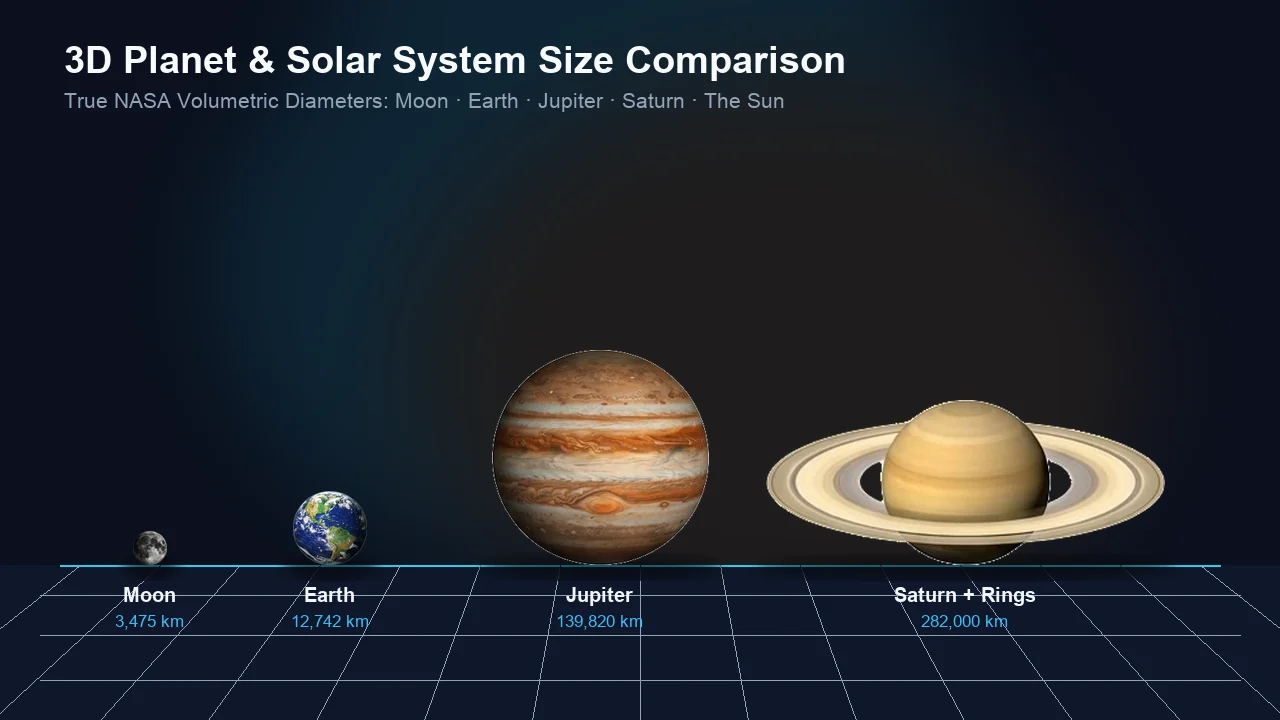
Complete 14-World NASA Diameter & Earth-Ratio Reference
Every celestial body in this mode uses volumetric mean diameter (or stated ring-plane span for Saturn) published in the NASA Goddard Space Flight Center Planetary Fact Sheets. Click any 1:1 3D View link below to load that exact pair onto our dual-pedestal showroom stage:
| Celestial Body | Classification | Verified Diameter | Ratio vs. Earth (12,742 km) | Instant 1:1 3D View |
|---|---|---|---|---|
| Ceres | Asteroid belt dwarf planet | 939.4 km (584 mi) | 0.074× Earth (width of Texas!) | Ceres vs. Pluto 3D ↗ |
| Pluto | Kuiper belt dwarf planet | 2,376.6 km (1,477 mi) | 0.187× Earth (narrower than Australia) | Pluto vs. Moon 3D ↗ |
| Earth's Moon | Terrestrial satellite | 3,474.8 km (2,159 mi) | 0.273× Earth (3.67 Moons = 1 Earth) | Moon vs. Earth 3D ↗ |
| Mercury | Inner rocky planet | 4,879.4 km (3,032 mi) | 0.383× Earth (40% wider than Moon) | Moon vs. Mercury 3D ↗ |
| Titan | Saturn's largest moon | 5,150 km (3,200 mi) | 0.404× Earth (5.5% wider than Mercury!) | Mercury vs. Titan 3D ↗ |
| Ganymede | Jupiter's largest moon | 5,268 km (3,273 mi) | 0.413× Earth (Solar System's largest moon) | Mercury vs. Ganymede 3D ↗ |
| Mars | Inner rocky planet | 6,779 km (4,212 mi) | 0.532× Earth (just over half Earth's width) | Mars vs. Earth 3D ↗ |
| Venus | Inner rocky planet | 12,103.6 km (7,521 mi) | 0.950× Earth (Earth's true size twin) | Venus vs. Earth 3D ↗ |
| Earth | Terrestrial planet | 12,742 km (7,918 mi) | 1.00× Baseline | Earth vs. Neptune 3D ↗ |
| Neptune | Ice giant planet | 49,244 km (30,599 mi) | 3.86× Earth (denser & smaller than Uranus) | Neptune vs. Uranus 3D ↗ |
| Uranus | Ice giant planet | 50,724 km (31,518 mi) | 3.98× Earth (almost exactly 4× Earth) | Earth vs. Uranus 3D ↗ |
| Jupiter | Gas giant planet | 139,820 km (86,881 mi) | 10.97× Earth (~11 Earths across equator) | Earth vs. Jupiter 3D ↗ |
| Saturn (Main Rings) | Ringed gas giant | 282,000 km (175,227 mi) | 22.13× Earth across A–C ring tips | Jupiter vs. Saturn 3D ↗ |
| The Sun | G-type main-sequence star | 1,392,700 km (865,384 mi) | 109.3× Earth / 9.96× Jupiter | Earth vs. Sun 3D ↗ |
Four Cosmic Proportions That Surprise Astronomy Fans
1. Earth to Moon Size Comparison: A 11-to-3 Ratio
Ask casual players to drag the Moon beside Earth and half make it tiny like Phobos while the other half make it half of Earth's width. A memorable ancient geometry shortcut locks it in: the Moon is 27.3% of Earth's diameter (almost an exact 3 : 11 ratio). Laid across North America, the Moon's 3,475 km width stretches from New York City to Denver—large enough to rank as the fifth-largest satellite in the entire Solar System.
2. Mars Is Half as Wide as Earth (Not Nearly Equal!)
Because Mars has seasons, polar ice caps, and 24.6-hour days—and stars alongside Earth in colonization headlines—many players drag Mars to 85% or 90% of Earth's diameter. In reality, Mars (6,779 km) is 53.2% of Earth's width. Because sphere surface area scales with d², Mars's dry rust desert surface (144.8 million km²) almost exactly equals Earth's dry land area excluding oceans (148.9 million km²)!
3. The Four Distinct Planetary Size Tiers
To keep Survival streaks alive past Round 10 when 🔥 Blind Eye hides live kilometer numbers, memorize four clean astronomical rungs:
- Dwarf & Lunar Tier (940 km – 5,270 km): Ceres (~1/4 Moon) → Pluto (~2/3 Moon) → Moon → Mercury / Titan / Ganymede (tightly clustered around 5,000 km).
- Terrestrial Pair (~6,800 km – 12,742 km): Mars is half an Earth; Venus (95%) and Earth are nearly indistinguishable twins.
- Ice Giants (~50,000 km): Both Neptune (3.86×) and Uranus (3.98×) stand four Earths tall.
- Jovian & Solar Giants (140,000 km – 1.39M km): Jupiter spans 2.76× Uranus (11 Earths); Saturn's main icy rings double Jupiter's width; the Sun spans 10 Jupiters across.
4. Earth to Sun Size Comparison: The 109× Horizon
Because the Sun and Moon both subtend ~0.5 degrees of arc in Earth's daytime and eclipse sky, human intuition struggles to internalize that the Sun sits ~400 times farther away and is 400 times wider than the Moon (109.3× wider than Earth). On our 1:1 Showroom stage, selecting Jupiter vs. The Sun bridges that 10× final leap cleanly.
Switch to Orbital Rockets, Countries, or Today's Daily 5
Ready to step back down to atmospheric engineering? Compare orbital launch vehicles like Apollo Saturn V, SLS, Hubble, JWST, and SpaceX Starship in Vehicle Size Comparison Game, explore 84 equal-area territories in Country Size Comparison Game, use our STEM Classroom Scale Lesson Plan, or return to the Size Comparison Game homepage for today's global Daily 5.
Be the first calibrator to post today's score or suggest a new comparison object.