Cinema blockbusters popularized paleontology worldwide while scrambling public intuition about dinosaur scale. On movie screens, dromaeosaurs open kitchen doors at human eye height, ceratopsians tower like two-story buildings, and theropods change height between camera cuts. When paleontologists measure articulated museum mounts—such as FMNH PR 2081 ('Sue') at the Field Museum—or reconstruct titanosaur skeletons from dorsal vertebrae and femora, the real biological hierarchy is far more nuanced.
Eight Iconic Dinosaurs Measured Against Modern Benchmarks
Every prehistoric species in our Animal Size Comparison Game scales along an explicit anatomical axis (Standing head height for vertical sauropods; Snout-to-tail length for horizontal quadrupeds and theropods). Click any 1:1 3D link to inspect the specimen live:
| Dinosaur Species | Period | Measured Axis | Verified Dimension | Modern Benchmark & 1:1 3D Launch |
|---|---|---|---|---|
| Velociraptor mongoliensis | Late Cretaceous | Snout-to-tail | 2.07 m (6 ft 9 in) | Hip-high (~0.5 m); Velociraptor vs. Human 3D ↗ |
| Ankylosaurus magniventris | Late Cretaceous | Nose-to-club | 8.00 m (26 ft 3 in) | Matches Orca length; Ankylosaurus vs. Car 3D ↗ |
| Stegosaurus stenops | Late Jurassic | Snout-to-tail | 9.00 m (29 ft 6 in) | 1.8 m shorter than a school bus; Stegosaurus vs. Bus 3D ↗ |
| Triceratops horridus | Late Cretaceous | Snout-to-tail | 9.00 m (29 ft 6 in) | Skull + frill is ~2.5 m; Triceratops vs. Bus 3D ↗ |
| Tyrannosaurus rex ('Sue') | Late Cretaceous | Snout-to-tail | 12.3 m (40 ft 4 in) | 1.5 m longer than a school bus; T. rex vs. Bus 3D ↗ |
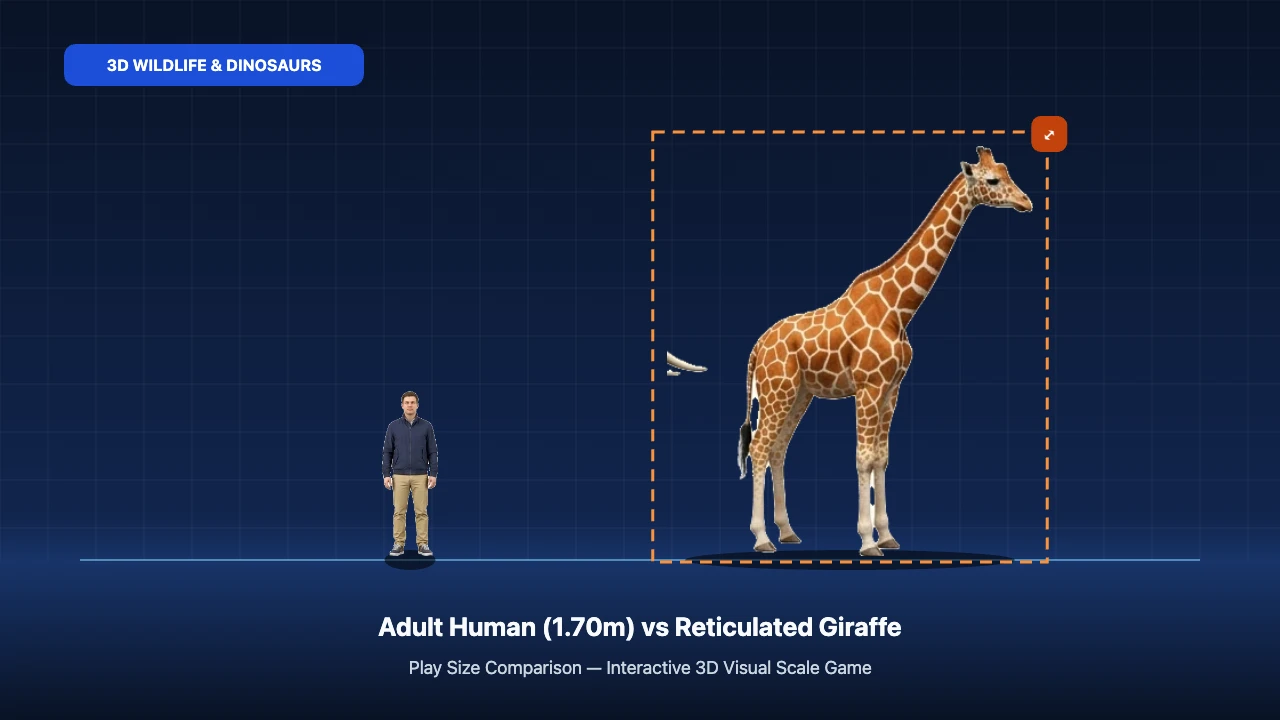
| Brachiosaurus altithorax | Late Jurassic | Standing height | 13.0 m (42 ft 8 in) | Four-story building crown; Brachiosaurus vs. Giraffe 3D ↗ |
| Spinosaurus aegyptiacus | Mid-Cretaceous | Snout-to-tail | 15.0 m (49 ft 3 in) | Longest theropod; Spinosaurus vs. T. rex 3D ↗ |
| Argentinosaurus huinculensis | Late Cretaceous | Snout-to-tail | 35.0 m (114 ft 10 in) | 5 m longer than a blue whale; Argentinosaurus vs. Whale 3D ↗ |
Three Paleontological Scale Traps That Fool Players
1. The Velociraptor vs. Deinonychus Swap
When Michael Crichton wrote Jurassic Park, he followed a short-lived 1988 taxonomic proposal that grouped North America's larger Deinonychus antirrhopus (~3.4 m long) under the genus Velociraptor—and film designers then scaled the creatures up to ~1.8 meters tall so puppeteers could operate them. Real Mongolian Velociraptor specimens weighed roughly 15 kg (33 lb), about the size of a wild turkey or coyote, with over half their 2.07-meter length formed by a rod-stiffened counterbalance tail.
2. Horizontal Theropod Posture vs. Vintage "Kangaroo" Mounts
Early twentieth-century museum halls mounted Tyrannosaurus rex upright with its tail dragging on the floor, pushing its skull past 6 meters high. Modern biomechanical mounts balance the massive skull horizontally across the hip socket with the muscular tail extended straight behind. Consequently, 'Sue' stands roughly 3.7 to 4.0 meters tall at the hips, while stretching 12.3 meters horizontally.
3. Sauropods vs. Blue Whales: Linear Length vs. Body Mass
While Argentinosaurus (35.0 m) exceeds the Antarctic Blue Whale (29.9 m) in linear nose-to-tail length thanks to its long counterbalanced neck and whiplash tail, seawater buoyancy still makes the Blue Whale more than twice as heavy (up to 190 metric tons vs. ~70–85 metric tons).
Test your prehistoric eye in Animal Size Comparison Game or compare dinosaurs against trucks and jets in Vehicle Size Comparison Game.