Every autumn, viral dashcam clips from Alaska, Maine, Canada, and Sweden shock millions of viewers with the same realization: moose are not deer-sized. Photographed alone in tall boreal spruce meadows with no human doorway or parked car in frame, Alces alces tricks the brain into applying white-tailed deer proportions (~1.0 m shoulder height). Only when an Alaskan Bull Moose (Alces alces gigas) steps onto a two-lane highway beside a sedan or SUV does the human brain register that Ice Age megafauna still walk northern forests today.
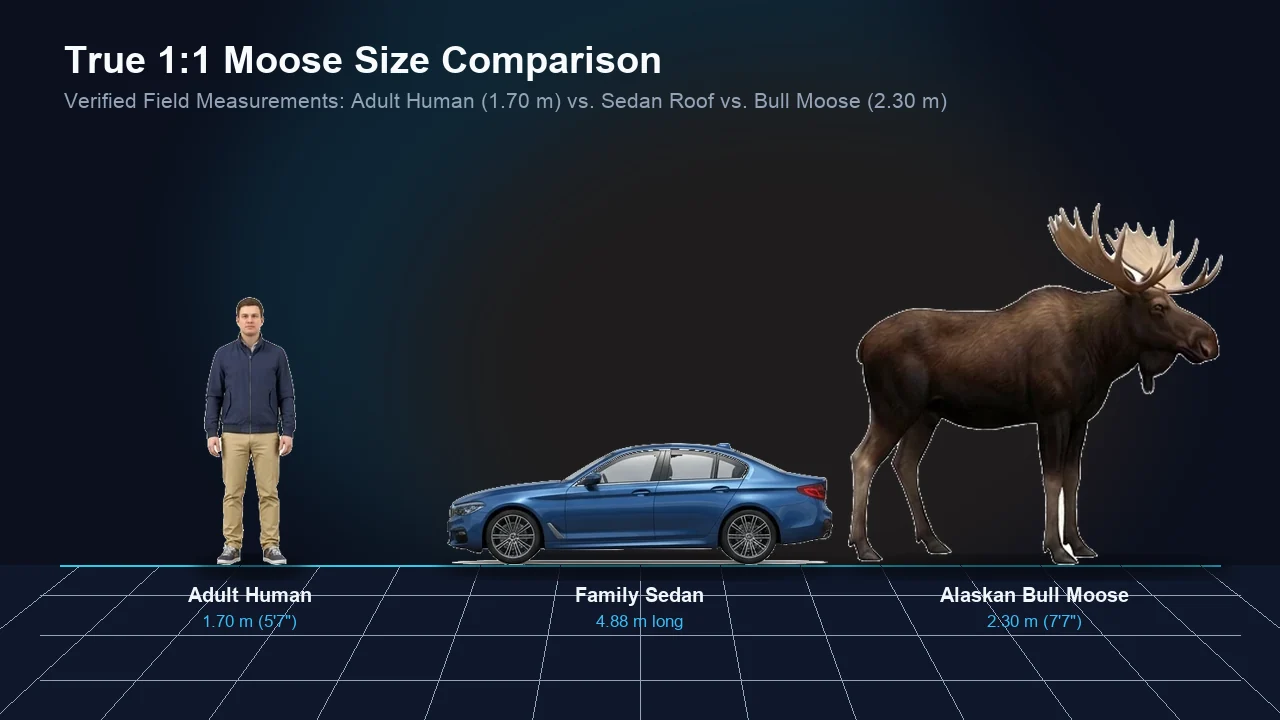
Verified Moose Size Comparison Table (1:1 Interactive Links)
Field biologists at the Alaska Department of Fish and Game document mature Alaskan and Yukon bulls weighing 540 to 725 kg (1,200 to 1,600 lb)—with record bulls reaching 820 kg (1,808 lb)—and antler racks spanning 1.80 meters (6 feet) from palm tip to palm tip. Click any link below to inspect the exact 1:1 3D scale comparison on our showroom floor:
| Compared Subject | Measured Axis | Verified Dimension | Visual Scale vs. Bull Moose (2.30 m Crown) | Launch 1:1 in 3D |
|---|---|---|---|---|
| Average Adult Human | Standing height | 1.70 m (5 ft 7 in) | Human head barely reaches the moose's chin bell (dewlap) | Moose vs. Human in 3D ↗ |
| Residential Wooden Door | Standard frame height | 2.03 m (6 ft 8 in) | Moose antlers clear the top of a standard house doorway by 27 cm! | Moose vs. Doorway in 3D ↗ |
| Mid-Size Family Sedan | Overall length / 1.44 m roof | 4.88 m long | Moose stands 60% taller than the car's roof! | Moose vs. Family Car in 3D ↗ |
| Northwestern Gray Wolf | Nose-to-tail length | 1.65 m (5 ft 5 in) | A single moose outweighs an entire 8-wolf pack combined | Moose vs. Wolf in 3D ↗ |
| Adult Male Ostrich | Crown height | 2.50 m (8 ft 2 in) | Ostrich neck reaches 20 cm higher, at one-fifth the body mass | Moose vs. Ostrich in 3D ↗ |
| Adult Male Polar Bear | All-fours body length | 2.55 m (8 ft 4 in) | Similar mass (~600 kg), but moose stands much taller on long legs | Moose vs. Polar Bear in 3D ↗ |
| African Bush Elephant | Shoulder height | 3.30 m (10 ft 10 in) | Elephant towers another full meter above the moose's antlers | Moose vs. Elephant in 3D ↗ |
Three Anatomical Reasons Moose Look Larger Than Horses
1. Snow-Stilt Leg Geometry & Highway Underride Physics
To wade through 1-meter subarctic snowpack and submerged marsh timber without bogging down, a moose's legs measure 1.1 to 1.3 meters from hoof to belly. That high clearance creates a critical highway safety hazard documented by transportation engineers: when a passenger sedan (~0.75 m hood height) strikes a deer, the bumper pushes the animal aside; when a sedan strikes a bull moose, the car's bumper sweeps out the thin lower legs and drops the 650-kilogram torso directly onto the windshield and A-pillars.
2. The Muscular Shoulder Hump
Unlike horses or elk with level backs, a moose possesses elongated thoracic vertebrae spines supporting massive neck ligaments needed to carry 25 to 35 kg (55–77 lb) of solid bone antlers regrown from scratch every single spring and summer—the fastest-growing animal tissue on Earth (up to 2.5 cm per day!). Even after bulls shed their antlers in winter, that shoulder hump remains 2.0+ meters high.
3. Regional Subspecies Gradient (Shiras vs. Alaskan Moose)
Not every moose reaches Alaskan giant dimensions. North America hosts four subspecies following Bergmann's ecogeographical rule (colder climates favor larger heat-retaining body volume):
- Shiras Moose (Rocky Mountains — Wyoming, Colorado, Montana): Smallest subspecies, bulls ~1.75 m at shoulder and 380–500 kg.
- Eastern & Northwestern Moose (Maine, Ontario, Minnesota, Sweden): Bulls ~1.85–1.95 m at shoulder and 450–600 kg.
- Alaskan Moose (Alaska & Yukon): Largest deer species alive today, standing 2.0–2.1 m at the shoulder and 2.30+ m to antler tips.
Moose vs. Elk, White-Tailed Deer & Domestic Horses
Because travelers frequently confuse North American cervids at a distance, comparing verified adult male dimensions side by side clarifies the hierarchy immediately:
- White-Tailed Deer Buck: Stands roughly 0.95 to 1.05 meters (3.3 ft) at the shoulder and weighs 70 to 135 kg (150–300 lb)—less than one-fifth the body mass of an Alaskan bull moose.
- Rocky Mountain Bull Elk (Wapiti): Stands 1.45 to 1.55 meters (5 ft) at the shoulder (reaching ~2.1 m with sweeping branched antlers) and weighs 315 to 400 kg (700–880 lb)—still roughly 50 centimeters lower at the shoulder and 250 kg lighter than a prime Alaskan bull moose.
- Thoroughbred Riding Horse: Averages 1.60 to 1.70 meters (16–16.3 hands) at the withers and ~500 kg, meaning an Alaskan bull moose stands 35 to 45 centimeters (over a foot) higher at the shoulder hump than a tall saddle horse!
- Clydesdale or Shire Draft Horse: Only giant heavy draft breeds (~1.80–1.95 m at the withers and 800–1,000 kg) rival a bull moose in standing shoulder elevation.
Test how accurately you can scale an Alaskan bull moose against lions, tigers, dinosaurs, and vehicles in Animal Size Comparison Game or Vehicle Size Comparison Game.