In a peer-reviewed megalodon vs mosasaurus size comparison, Otodus megalodon wins decisively on total body mass, jaw gape, and bite force, while the largest Mosasaurus hoffmannii individuals nearly matched mid-sized female megalodons in snout-to-tail length. Specifically, 3D morphometric reconstructions place mature female Otodus megalodon at 15.3 to 20.0 meters (50–65 ft) and 50 to 70+ metric tons, whereas the largest Mosasaurus hoffmannii fossils reconstruct to 13.0 to 17.1 meters (43–56 ft) and 14 to 20 metric tons—meaning a 16-meter megalodon weighed roughly three times more than a similarly long mosasaur!
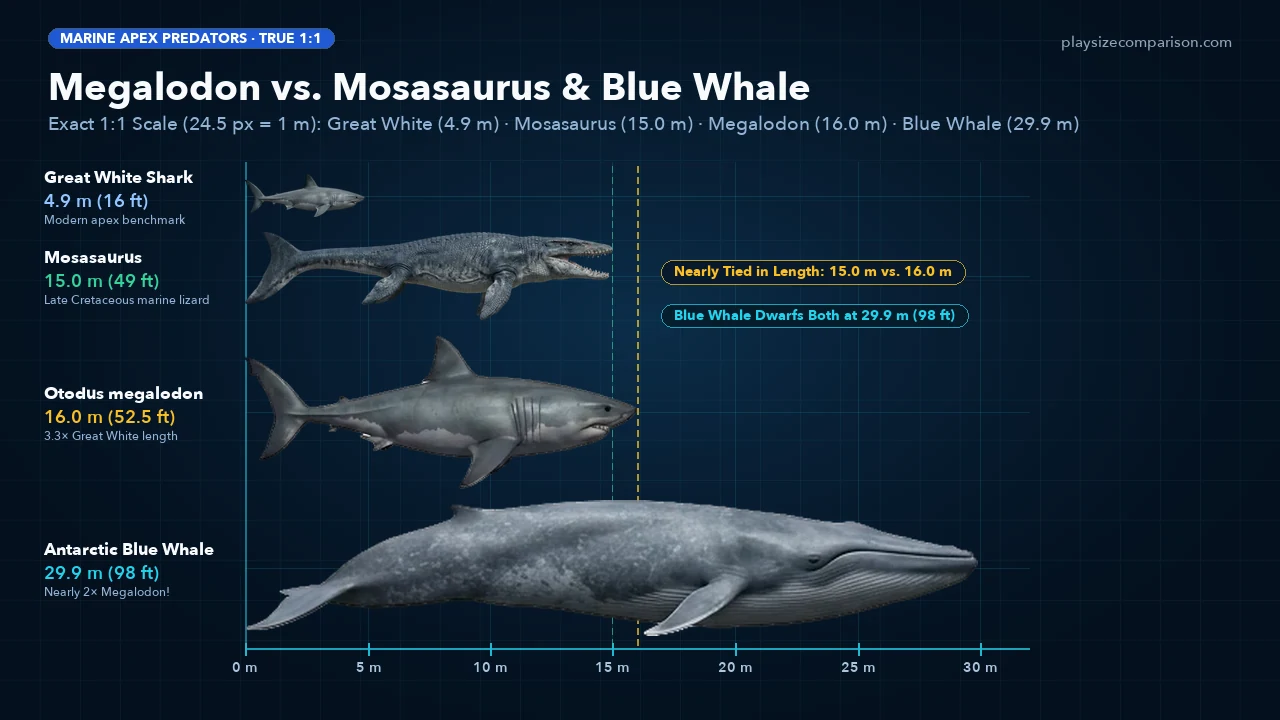
All measurements below draw directly from peer-reviewed paleobiology—including Cooper et al. (2020, Scientific Reports, DOI: 10.1038/s41598-020-71387-y), Cooper et al. (2022, Science Advances), and Grigoriev (2014, Proceedings of the Zoological Institute RAS) on the giant Penza Mosasaurus hoffmannii specimen (PRM 2836). Launch any #compare= link below to view the 3D models at exact 1:1 scale!
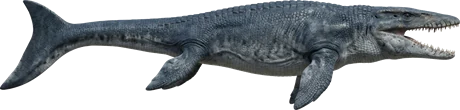 Mosasaurus hoffmannii15.0 m · ~15–20 tons
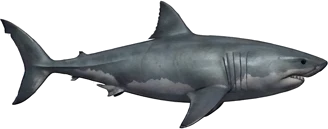 Otodus megalodon16.0 m · ~50–70 tons
Side-by-Side Table: Megalodon vs. Mosasaurus & Ocean Benchmarks
| Marine Species / Benchmark | Verified Length | Body Mass | Peak Bite Force / Trait | Geological Era | Live 1:1 3D Viewer |
|---|---|---|---|---|---|
| Mature Great White Shark | 4.9 – 6.1 m |
1,100 – 1,900 kg |
~18,216 N posterior bite |
Modern (0 Ma) |
Great White vs. Megalodon ↗ |
| Male Orca (Killer Whale) | 8.0 – 9.8 m |
6,000 – 9,500 kg |
Echolocation + cooperative pod hunting | Modern (0 Ma) |
Orca vs. Mosasaurus ↗ |
| Type-C Yellow School Bus | 10.8 m |
6,500 kg (curb) |
Standard highway visual ruler | Modern | School Bus vs. Mosasaurus ↗ |
| Tyrannosaurus rex ('Sue') | 12.3 m |
8,400 – 9,500 kg |
35,000 – 57,000 N terrestrial bite |
Late Cretaceous (68–66 Ma) |
T. rex vs. Megalodon ↗ |
| Mosasaurus hoffmannii | 13.0 – 17.1 m |
14,000 – 20,000 kg |
Pterygoid throat-ratchet teeth; air-breathing squamate | Late Cretaceous (72–66 Ma) |
Mosasaurus vs. Megalodon ↗ |
| Adult Bull Sperm Whale | 16.0 – 18.5 m |
45,000 – 57,000 kg |
230 dB biosonar; 2,000 m squid dives |
Modern (0 Ma) |
Sperm Whale vs. Megalodon ↗ |
| Otodus megalodon | 15.3 – 20.0 m |
50,000 – 70,000+ kg |
108,514 – 182,201 N (2.7×–3.2× m wide gape) |
Miocene–Pliocene (23–3.6 Ma) |
Megalodon vs. Blue Whale ↗ |
| Antarctic Blue Whale | 29.9 m |
150,000 – 190,000 kg |
Heaviest animal in Earth's entire history | Modern (0 Ma) |
Blue Whale vs. Megalodon ↗ |
 Adult Human1.70 m (5 ft 7 in)Mosasaurus hoffmannii15.0 m (49 ft 3 in)
 Yellow School Bus10.8 m (35 ft 5 in)Mosasaurus hoffmannii15.0 m (49 ft 3 in)
Why Body Volume Separates a Shark From a Sea Lizard
Even when an exceptional 17.1-meter Mosasaurus hoffmannii (reconstructed by Grigoriev 2014 in Proceedings of the Zoological Institute RAS from a 1.6-meter lower jaw found in Penza, Russia) overlaps in total length with a 16-meter Otodus megalodon, their 3D silhouettes look completely different:
- Streamlined Monitor-Lizard Tail vs. Deep Fusiform Torpedo: Mosasaurs were giant marine squamate reptiles closely related to modern monitor lizards (Varanidae) and snakes. Nearly
45% to 50%of a mosasaur's total length consisted of a laterally compressed, hypocercal ribbon tail! By contrast, Otodus megalodon (modeled in 3D from an associated Belgian vertebral columnIRSNB P 9893by Cooper et al. 2022, Science Advances (NIH PMC)) carried a deep, barrel-shaped trunk (~3.5–4.0 mtall including the1.62 mdorsal fin) capable of engulfing an entire8-meterbaleen whale in5bites. - Bite Physics & Double-Hinged Jaws: Finite-element cranial modeling by Wroe et al. (2008, Journal of Zoology) calculated Otodus megalodon's posterior bite force between
108,514 Nand182,201 N—strong enough to shear straight through thick cetacean ribcages and flipper bones using276serrated18 cmtriangular teeth. Mosasaurus hoffmannii hunted differently: like snakes, it possessed palatal pterygoid teeth on the roof of its mouth and an intramandibular jaw joint to ratchet ammonites, sea turtles (Allopleuron), and smaller plesiosaurs down whole. - 43 Million Years Apart: Neither predator ever met! Mosasaurus ruled Maastrichtian shallow seas (
72–66 Ma) until the Chicxulub bolide collapsed marine food webs; Otodus megalodon rose43 millionyears later alongside warm-blooded cetaceans before Pliocene cooling and competition from ancestral Orcinus and great white sharks (Carcharodon carcharias) ended its reign at3.6 Ma. Compare50living and extinct giants right now in Animal Size Comparison Game!
Sources & Primary References
- Cooper, J. A. et al. (2020), Scientific Reports — Body Dimensions of the Extinct Giant Shark Otodus megalodon
- Cooper, J. A. et al. (2022), Science Advances (NIH PMC) — The Extinct Shark Otodus megalodon Was a Transoceanic Superpredator
- NOAA Fisheries — White Shark (Carcharodon carcharias) Species Profile
- Florida Museum of Natural History — White Shark Species Profile
- NOAA Fisheries — Blue Whale (Balaenoptera musculus) Species Profile