Discovered in 2009 inside the 58-to-60-million-year-old coal mines of Cerrejón, Colombia, Titanoboa cerrejonensis shattered every assumption about how large a land-dwelling reptile could grow after the dinosaur extinction. A titanoboa size comparison grounded in Head et al. (2009, Nature) and Florida Museum of Natural History vertebral regressions reveals a semi-aquatic Paleocene constrictor longer than a city transit bus.
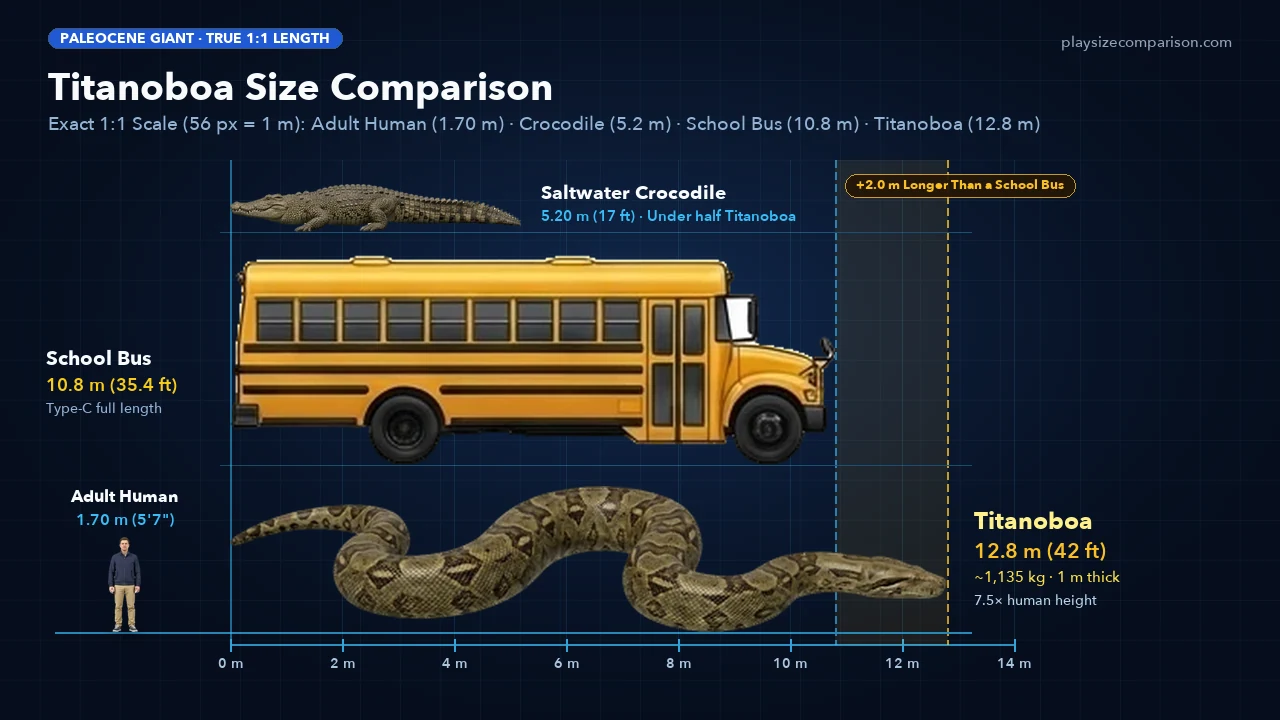
 Yellow School Bus10.8 m (35 ft 5 in)
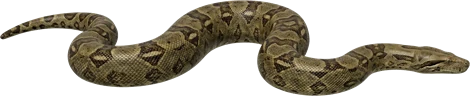 Titanoboa cerrejonensis12.8 m (42 ft 0 in)
Verified Length & Mass Table: Titanoboa vs. Living Reptiles, Buses & Dinosaurs
| Species or Benchmark Object | Verified Length | Estimated Mass | Comparison vs. Titanoboa (12.8 m) |
Live 3D Benchmark |
|---|---|---|---|---|
| Adult Human | 1.70 m (height) | ~70 kg | Titanoboa is 7.5× human height; ribcage waist-high (~1 m) |
Human vs. Titanoboa 3D ↗ |
| Saltwater Crocodile (Record Male) | 5.20 – 6.17 m | ~1,000 kg | Titanoboa is more than double a giant croc's length | Croc vs. Titanoboa 3D ↗ |
| Green Anaconda (Large Female) | 5.20 – 6.20 m | ~100 – 225 kg | Titanoboa is ~2.1× longer and 5× heavier | Anaconda vs. Titanoboa 3D ↗ |
| Reticulated Python (Longest Living) | 6.95 – 7.70 m | ~130 – 160 kg | Titanoboa exceeds modern pythons by over 5 meters (17 ft) | — |
| Type-C Yellow School Bus | 10.80 m | ~6,500 kg | Titanoboa overhangs a school bus by 2.0 meters (6.5 ft)! | Bus vs. Titanoboa 3D ↗ |
| Tyrannosaurus rex ('Sue') | 12.30 m | ~8,400 kg | Almost identical nose-to-tail length, though T. rex weighed 7× more | T. rex vs. Titanoboa 3D ↗ |
| Titanoboa cerrejonensis | 12.80 – 14.30 m | ~1,135 kg | Largest snake in Earth's fossil record (Paleocene epoch) | Titanoboa vs. Human 3D ↗ |
| Otodus megalodon | 15.0 – 16.0 m | ~50,000 kg | Marine apex shark out-lengths Titanoboa by ~2–3 m | Titanoboa vs. Megalodon 3D ↗ |
 Giant Green Anaconda6.0 m (19.7 ft)Titanoboa cerrejonensis12.8 m (42.0 ft)
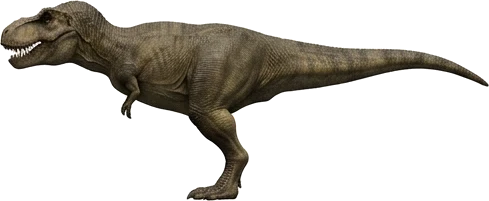 T. rex ('Sue')12.3 m · ~8.4 tonsTitanoboa12.8 m · ~1.1 tons
Why Paleocene Tropics Produced a 1.1-Ton Snake
Because snakes are ectothermic (cold-blooded), their maximum metabolic size is capped by ambient environmental temperature. Paleobotanists and vertebrate paleontologists led by Jason Head and Jonathan Bloch (Nature, 2009) demonstrated that for Titanoboa to sustain a 1,135-kilogram body without overheating or starving, equatorial South American rainforests 58 million years ago maintained mean annual temperatures around 30°C to 34°C (86°F–93°F)—acting as a biological thermometer for ancient Earth!
Skull Discovery, Fish-Eating Jaws & Rival Prehistoric Serpents
Follow-up expeditions to Colombia's Cerrejón coal basin by teams from the Smithsonian Tropical Research Institute and the Florida Museum of Natural History recovered 28 individual Titanoboa specimens—including rare diagnostic skull bones announced in 2013 that reshaped how paleontologists reconstruct its lifestyle:
- Semi-Aquatic Piscivore Rather Than Land Mammal Ambush Hunter: Titanoboa's elongated, low-slung quadrate bones and numerous loosely attached palatine teeth closely resemble modern aquatic file snakes and water-dwelling boids. Instead of crushing giant land mammals in dry trees, Titanoboa glided through murky Paleocene river channels preying on 3-meter lungfish, giant osteoglossid fishes, and juvenile crocodylomorphs.
- Sharing Rivers With Car-Sized Turtles: Cerrejón swamps teemed with oversized reptiles—including Carbonemys cofrinii, a freshwater side-necked turtle carrying a 1.72-meter (5 ft 8 in) shell the size of a compact car, and Acherontisuchus guajiraensis, a 5-to-6-meter narrow-snouted dyrosaurid crocodilian.
- Titanoboa vs. Vasuki indicus (2024): In 2024, researchers in Gujarat, India described 47-million-year-old Eocene madtsoiid snake vertebrae named Vasuki indicus (Datta & Bajpai, Scientific Reports) with estimated lengths of 10.9 to 15.2 meters. While Vasuki may have rivaled Titanoboa in slender terrestrial length, Titanoboa's broader dorsal vertebrae (
>12 cmwide) still hold the verified record for heaviest body mass (>1.1 metric tons) in serpent history.
Put your prehistoric scale intuition to the test across Velociraptor, Triceratops, Tyrannosaurus rex, Spinosaurus, Megalodon, and Argentinosaurus in Animal Size Comparison Game.
Sources & Primary References
- Head, J. J. et al. (2009), Nature 457: 715–717 — Giant Boid Snake from the Palaeocene Neotropics Reveals Hotter Past Equatorial Temperatures
- Florida Museum of Natural History — Titanoboa Fossil Research Archive
- Datta, D. & Bajpai, S. (2024), Scientific Reports — Largest Known Madtsoiid Snake (Vasuki indicus)
- Field Museum — SUE the Tyrannosaurus rex (FMNH PR 2081)
- The Australian Museum — Estuarine (Saltwater) Crocodile Benchmark