In a verified saltwater crocodile size comparison, a mature male Crocodylus porosus measuring 5.20 meters (17 ft 1 in) stretches more than three times the height of an adult human (1.70 m), overhangs a 4.88-meter midsize family sedan, and matches the length of a 4.90-meter mature great white shark. According to The Australian Museum and the University of Michigan Animal Diversity Web (ADW), adult male estuarine (saltwater) crocodiles typically measure 4.0 to 5.2 meters (13 to 17 ft) and weigh 400 to 1,000 kg (880 to 2,200 lb)—making C. porosus the largest and heaviest living reptile on Earth, with verified exceptional bulls surpassing 6.15 to 6.17 meters (20 ft 3 in) and 1,075 kg.
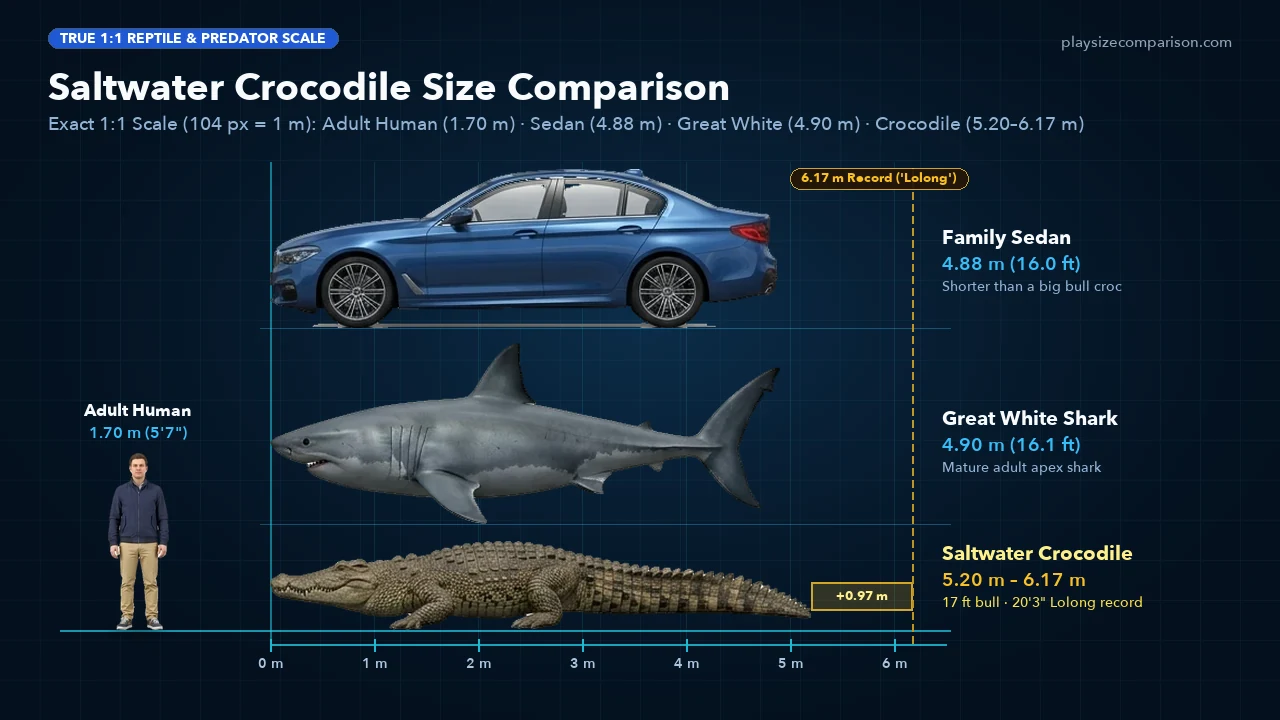
Wildlife footage taken from high riverbanks hides how massive a 5-meter crocodile looks at eye level because its low-slung belly sits close to the mud while half of its body stays submerged. Placing our 5.20-meter Saltwater Crocodile model directly beside familiar road and ocean benchmarks on a dry orthographic floor makes its true footprint unmistakable. Launch our 1:1 Saltwater Crocodile vs. Adult Human 3D Viewer right now to inspect the proportion interactively!
 Adult Human1.70 m (5 ft 7 in)
 Saltwater Crocodile5.20 m (17 ft 1 in)
Verified 1:1 Saltwater Crocodile Size Comparison Table
Every benchmark below matches our verified 269-item 3D catalog, reconciled against The Australian Museum, Queensland Government crocodile profiles, U.S. National Park Service Everglades species data, and NOAA Fisheries. Click any Launch 1:1 in 3D link to view both models side by side:
| Compared Species or Benchmark | Measured Axis | Verified Dimension | Typical Mass | Scale vs. 5.20 m Saltwater Croc | Live 1:1 3D Viewer |
|---|---|---|---|---|---|
| Average Adult Human | Standing height | 1.70 m (5 ft 7 in) | ~70 kg | Croc is 3.06× human height (Lolong: 3.63×) | Human vs. Croc in 3D ↗ |
| Adult Komodo Dragon | Total length | 2.60 m (8 ft 6 in) | 70–90 kg | Croc is 2.0× longer and 8×–10× heavier | Komodo vs. Croc in 3D ↗ |
| American Alligator (Adult Male) | Total length | 3.40 – 4.30 m (11–14 ft) | 120–250+ kg | Large saltwater croc is 20%–40% longer & 2×–4× heavier | — |
| Nile River Hippopotamus | Body length | 4.20 m (13 ft 9 in) | 1,500–3,000 kg | Shorter than a big croc, yet 2×–3× heavier | Hippo vs. Croc in 3D ↗ |
| Mid-Size Family Sedan | Bumper-to-bumper | 4.88 m (16 ft 0 in) | ~1,550 kg | 5.20 m croc overhangs a sedan by 32 cm! | Sedan vs. Croc in 3D ↗ |
| Mature Great White Shark | Total length | 4.90 m (16 ft 1 in) | 1,100–1,900 kg | Nearly tied in length, though shark has bulkier girth | Shark vs. Croc in 3D ↗ |
| Saltwater Crocodile (Large Male) | Snout-to-tail | 5.20 m (record: 6.17 m) | 500–1,075 kg | Largest living reptile on Earth | Play 3D Animal Scale ↗ |
| Type-C Yellow School Bus | Overall length | 10.80 m (35 ft 5 in) | ~6,500 kg | Equals 2.08 large saltwater crocodiles end to end | Bus vs. Croc in 3D ↗ |
| Tyrannosaurus rex ('Sue') | Snout-to-tail | 12.30 m (40 ft 4 in) | 8,400–9,500 kg | 2.37× longer and ~10× heavier than a 5.2 m croc | Croc vs. T. rex in 3D ↗ |
Catalog Reconciliation: Average Males, Extreme Sexual Dimorphism & Verified 6-Meter Giants
Crocodilian folklore is notorious for inflated 8-meter tales based on stretched hides (fresh skin stretches 15% to 25% after flaying!). Distinguishing verified live measurements from myths clarifies the exact size ladder:
- Extreme Sexual Dimorphism: Crocodylus porosus shows the widest male-to-female size gap of any living crocodilian. While adult females rarely exceed 2.5 to 3.2 meters (8.2 to 10.5 ft) and 80 to 150 kg, mature territorial males routinely grow past 4.5 to 5.2 meters—our 3D catalog's 5.20 m benchmark represents a prime large wild bull, not an unverified outlier.
- Verified 6-Meter Records: Two gold-standard scientific measurements anchor the upper ceiling of modern C. porosus. First, Lolong—captured in Bunawan, Agusan del Sur, Philippines in 2011 and officially measured on a level tape—reached 6.17 meters (20 ft 3 in) and 1,075 kilograms (2,370 pounds). Second, The Australian Museum documents Australia's largest reliably measured specimen from the Mary River, Northern Territory (1974): its headless carcass measured 548 ± 8 cm, and its 66.6-centimeter midline skull length corresponded to a total length of at least 6.15 meters.
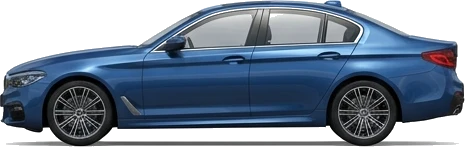 Mid-Size Sedan4.88 m (16 ft 0 in)Saltwater Crocodile5.20 m (17 ft 1 in)
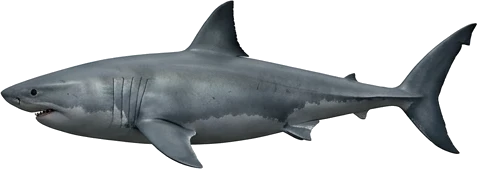 Great White Shark4.90 m (16 ft 1 in)Saltwater Crocodile5.20 m (17 ft 1 in)
Saltwater Crocodile vs. American Alligator & Nile Crocodile
North American readers often ask how Crocodylus porosus stacks up against familiar Florida alligators and African Nile crocodiles:
- Length & Cubic Mass Scaling (
L³): Because body volume scales with the cube of linear length, adding just 1 meter of length transforms mass dramatically. Moving from a 3.8-meter adult male American alligator (~200–250 kg, per NPS Everglades) up to a 5.2-meter male saltwater crocodile multiplies length by 1.37×, which pushes cubic body mass (1.37³ ≈ 2.57×) and broad estuarine head/tail musculature to 600–900+ kg! - Nile Crocodile (Crocodylus niloticus): Earth's second-largest living reptile averages 3.5 to 5.0 meters and 225 to 750 kg, overlapping heavily with typical saltwater crocodiles while falling just short of C. porosus in maximum verified coastal mass.
- Snout Width & Salt Glands: Unlike freshwater alligators, saltwater crocodiles possess specialized lingual salt-excreting glands on the tongue that allow adult bulls to swim hundreds of kilometers across open ocean currents between northern Australia, Papua New Guinea, Indonesia, the Philippines, and eastern India.
Record Bite Force Physics: 16,414 Newtons Directly Measured
Size alone does not explain why saltwater crocodiles sit atop tropical coastal food webs. In a landmark 2012 biomechanical study published in PLOS ONE, Gregory M. Erickson and colleagues measured live bite forces across all 23 extant crocodilian species using custom piezo-electric transducers:
- Highest Living Bite Force Ever Recorded: A 4.59-meter male saltwater crocodile delivered 16,414 Newtons (3,700 pounds of force) at its posterior crushing teeth—exceeding adult American alligators (~9,452 N) by more than 70% and eclipsing African lions and spotted hyenas (~4,000–4,500 N) by nearly fourfold!
- Allometric Scaling to 6-Meter Giants: Erickson's regression model showed that crocodilian bite force scales tightly with body size rather than snout shape, projecting that a record 6.17-meter bull like Lolong could generate roughly 27,000 to 34,000 Newtons—overlapping lower-end estimates for prehistoric theropods!
- One-Way Muscle Asymmetry: Roughly 95% of a crocodile's jaw musculature powers closing the jaws (pterygoideus and adductor complexes), while the tiny jaw-opening muscles (depressor mandibulae) generate only a small fraction of that force—matching the biology of an ambush predator built to clamp water buffalo, sea turtles, and sharks and drag them underwater.
Compare our 5.20-meter Saltwater Crocodile directly against a family sedan, great white shark, or Tyrannosaurus rex, or test your eye across all 50 wildlife species in Animal Size Comparison Game.
Sources & Primary References
- The Australian Museum — Estuarine (Saltwater) Crocodile (Crocodylus porosus)
- Erickson, G. M. et al. (2012), PLOS ONE — Insights into the Ecology and Evolutionary Success of Crocodilians Revealed through Bite-Force and Tooth-Pressure Experimentation
- University of Michigan Museum of Zoology (ADW) — Crocodylus porosus (Saltwater Crocodile)
- Queensland Government — Living With Crocodiles (Biology & Size Guidelines)
- U.S. National Park Service (Everglades) — American Alligator Species Profile
- NOAA Fisheries — White Shark (Carcharodon carcharias) Species Profile