Students routinely memorize metric conversion formulas (1,000 mm = 1 m, 1,000 m = 1 km) while struggling to picture multiplicative scale in the physical world. Ask a middle-school or high-school class how many times taller the Eiffel Tower is than a classroom door, or how many Earths fit across the Sun's diameter, and intuitive guesses routinely scatter across two orders of magnitude.
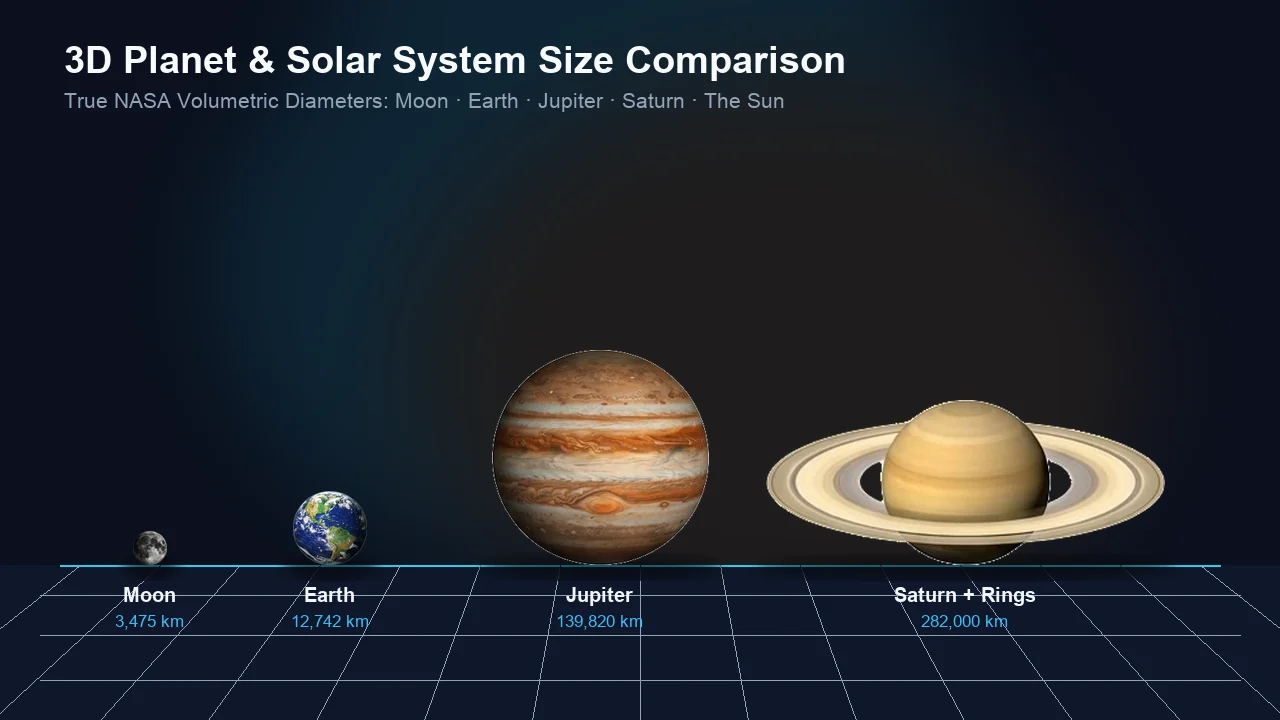
Because Play Size Comparison runs directly in any Chromebook, iPad, or classroom projector browser with zero student sign-ups, logins, or installs, educators use our 247-model 3D stage as a hands-on laboratory aligned with NGSS Crosscutting Concept 3 (Scale, Proportion, and Quantity).
Core Learning Objectives
By the end of a single 45-minute class period, students will be able to:
- Distinguish additive error ("off by 10 meters") from multiplicative ratio error ("2.0× too large vs. 0.5× too small") and explain why symmetric logarithmic scoring treats doubling and halving equally.
- Apply unit iteration (mental reference ladders) to estimate unfamiliar biological, architectural, and planetary sizes from everyday benchmarks.
- Prove geometrically why multiplying a two-dimensional territory's area by
kmultiplies its linear screen width and height by√k, busting Mercator wall-map illusions.
Step-by-Step 45-Minute Classroom Protocol
Part 1: Whole-Class Blind Eye Warmup (10 Minutes)
- Open the Size Comparison Game homepage on the classroom projector and toggle 🔥 Blind Eye in the top bar so live meter readouts stay hidden while dragging.
- Have students vote (Higher / Lower / Lock In!) as a student volunteer scales the target 3D model across all five Daily Expedition rounds.
- Flip between Metric and US Units after each lock-in so students connect meters and square kilometers directly to feet and square miles.
Part 2: Linear, Planetary & Equal-Area Lab Stations (20 Minutes)
Pair students on devices and assign three quick investigations using instant ?compare= deep-links:
- Station A — Five Orders of Magnitude (Linear): Inspect Chicken Egg vs. Guitar, Human vs. Bull Moose, School Bus vs. Blue Whale, and Statue of Liberty vs. Burj Khalifa—recording the exact multiplier at each step.
- Station B — Busting Mercator Wall Maps (Area): Open Country Size Comparison Game and compare Greenland vs. DR Congo, Sweden vs. Morocco, and UK vs. Michigan.
- Station C — Solar System Proportions (Astronomy): Open Planet Size Comparison Game and compare Moon vs. Earth (
3.67×), Mercury vs. Ganymede (a moon larger than a planet!), and Earth vs. Sun (109×).
Part 3: Same-Seed Classroom Ghost Duel (15 Minutes)
Have the teacher or a student finish a 5-round Daily run, click Challenge Friend (Ghost Duel), and write the ?duel= link on the board. Every student group plays the exact same five 3D pairs and sees how their translucent hologram estimate compares against the class benchmark!
Exit-Ticket Discussion Prompts
- Why does guessing 200 m for a 100 m rocket earn the exact same accuracy score as guessing 50 m?
- If Country B has 9 times the land area of Island A, how many times wider should Country B appear on an equal-area 3D stage? (Answer:
√9 = 3×wider and3×taller.) - Why do scientific illustrators render scale comparison charts in 0-degree orthographic projection rather than wide-angle perspective?
Need a specific historical monument, organism, or territory added for an upcoming curriculum unit? Message our team anytime via the Contact page.