Ask ten museum visitors which giant stood taller in an african elephant vs woolly mammoth size comparison, and nine will picture the Ice Age mammoth towering twice as high as any living elephant. Verified osteological records reverse that assumption: adult male woolly mammoths (Mammuthus primigenius) and modern African bush elephants (Loxodonta africana) were virtually the exact same size. In his landmark volumetric monograph in Acta Palaeontologica Polonica (2016), vertebrate paleontologist Asier Larramendi established that mature bull woolly mammoths stood 2.7 to 3.4 meters (8 ft 10 in to 11 ft 2 in) at the shoulder and weighed 5.0 to 6.0 metric tons (with rare giants like Germany's Siegsdorf specimen reaching 3.4 m and ~8.1 metric tons)—matching modern bull African bush elephants (3.04 to 3.36 m average shoulder height, 5.2 to 6.0+ metric tons, per University of Michigan ADW and Larramendi's extant baseline).
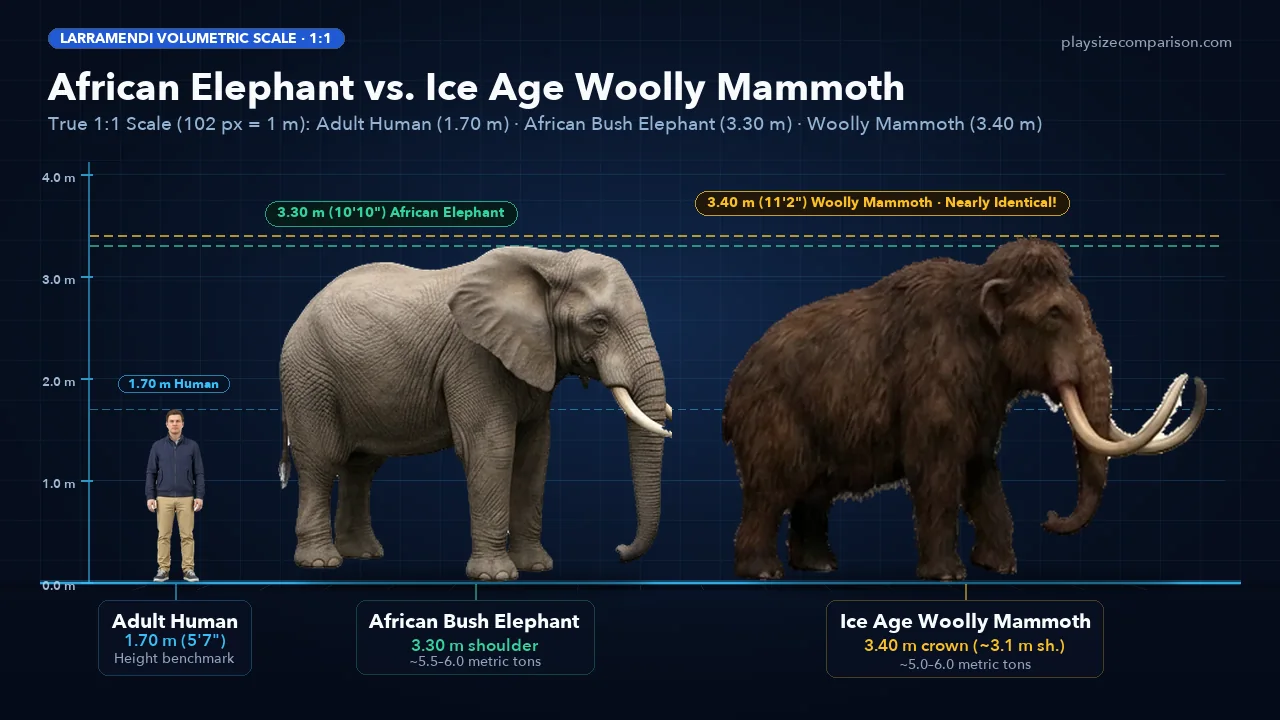
You can test that surprise right now by placing both 3D models side by side in our 1:1 African Elephant vs. Woolly Mammoth Viewer. In our 269-item catalog, the African Bush Elephant (Bull) measures 3.30 m (10 ft 10 in) at the shoulder while the Ice Age Woolly Mammoth measures 3.40 m (11 ft 2 in) at its high domed crown—just 10 centimeters (4 inches) apart!
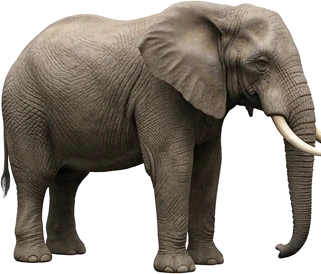 African Bush Elephant3.30 m shoulder (10 ft 10 in)
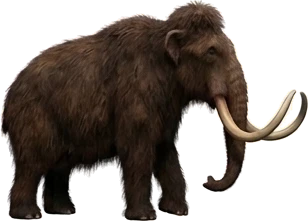 Ice Age Woolly Mammoth3.40 m crown (11 ft 2 in)
Verified Proboscidean & Megafauna Size Table (Metric & Imperial)
Every dimension below reconciles our 269-item orthographic catalog with Larramendi (2016) Graphic Double Integration (GDI) body-mass estimates, UC Museum of Paleontology (Berkeley), and U.S. Fish & Wildlife Service ECOS species profiles. Click any Launch 1:1 in 3D link to inspect the exact proportion on our showroom floor:
| Species or Benchmark | Measured Axis | Verified Dimension | Adult Body Mass | Key Scale Takeaway | Live 1:1 3D Viewer |
|---|---|---|---|---|---|
| Average Adult Human | Standing height | 1.70 m (5 ft 7 in) | ~70 kg | Clears only half an elephant's shoulder height | Human vs. Mammoth 3D ↗ |
| Alaskan Bull Moose | Antler crown height | 2.30 m (7 ft 7 in) | 540–725 kg | Tallest living deer; 1.0 m below elephant shoulder | Moose vs. Elephant 3D ↗ |
| Asian Elephant (Bull) | Shoulder height | 2.70 – 3.00 m (8.9–9.8 ft) | 4.0–5.0 t | Closest living genetic cousin to M. primigenius | — |
| Woolly Mammoth (M. primigenius, bull) | Shoulder / crown height | 2.70 – 3.40 m (catalog: 3.40 m) | 5.0–6.0 t (max ~8.1 t) | Virtually tied in height with African bush elephant | Elephant vs. Mammoth 3D ↗ |
| African Bush Elephant (L. africana, bull) | Shoulder height | 3.04 – 3.36 m (catalog: 3.30 m) | 5.2–6.0+ t (record ~10.4 t) | Largest living land animal; up to 3.96 m extreme | Human vs. Elephant 3D ↗ |
| Columbian Mammoth (M. columbi, bull) | Shoulder height | 3.90 – 4.10 m (12.8–13.5 ft) | 9.0–11.0 t | Temperate North American cousin; ~25% taller! | — |
| Southern White Rhinoceros | Head-and-body length | 4.00 m (13 ft 1 in) | 2.3 t | Matches elephant mass at ~40% of its weight | Rhino vs. Mammoth 3D ↗ |
| Reticulated Giraffe (Bull) | Standing height | 5.50 m (18 ft 1 in) | 1.2–1.6 t | Stands 2.1 m taller than a mammoth at 1/4 the mass | Giraffe vs. Mammoth 3D ↗ |
| Tyrannosaurus rex ('Sue') | Snout-to-tail / ~3.8 m hip | 12.30 m (40 ft 4 in) | 8.4–9.5 t | Hip height matches a giant elephant's shoulder! | Mammoth vs. T. rex 3D ↗ |
Transparent Catalog Reconciliation: Shoulder Height vs. Crown Height
Reading fossil charts without checking measurement axes causes constant confusion in woolly mammoth vs african elephant comparisons:
- Skeletal Shoulder Height (sSH) vs. Height in the Flesh: As Larramendi (2016) demonstrated by re-measuring historic mounted skeletons (including the famous African bull "Jumbo", AMNH 3283, at ~3.23 m), adding soft tissue—the fibrous foot cushion, scapular cartilage, and dorsal muscle layer—raises live shoulder height roughly 5% to 7% above dry bone stacks. Conversely, overly straightened vintage museum mounts sometimes inflated skeletal heights by 20–30 centimeters.
- High-Domed Crown & Sexual Dimorphism: Woolly mammoth bulls averaged 2.7 to 3.4 m at the shoulder (and females 2.6 to 2.9 m, ~4.0 t), while our 3D catalog's 3.40 m Crown height reflects a large adult bull's profile including its high skull crest and winter shoulder hump—right beside our 3.30 m bull African Bush Elephant shoulder benchmark. Meanwhile, isolated dwarf woolly mammoths that survived on Wrangel Island off Siberia until roughly 4,000 years ago shrank to ~1.8–2.3 m shoulder height!
Why Pop Culture Overestimates the Woolly Mammoth
If Mammuthus primigenius stood roughly nose-to-nose with a savanna bull elephant, why do illustrations routinely portray mammoths as 5-meter monsters?
- Species Confusion With Steppe and Columbian Mammoths: The genus Mammuthus spanned multiple distinct species across Eurasia and North America. While the shaggy Arctic Woolly Mammoth (M. primigenius) evolved a compact, heat-conserving frame on the cold Bering Land Bridge mammoth steppe, its warmer-climate relatives—the Eurasian Steppe Mammoth (Mammuthus trogontherii, ~4.0–4.3 m, ~10–12 t) and the North American Columbian Mammoth (Mammuthus columbi, ~3.9–4.1 m, ~9–11 t)—genuinely dwarfed both woolly mammoths and modern African elephants.
- Shaggy Silhouette & Sweeping Tusks: A 90-centimeter outer coat of coarse guard hair over dense underwool, an 8-to-10-centimeter subcutaneous fat layer, and huge curving ivory tusks added dramatic visual bulk even when skeletal limb lengths matched modern Loxodonta.
- Saddle-Back vs. Sloped-Back Posture: An African bush elephant carries a level-to-dipped middle back with its highest point directly above the forelimb shoulders. A woolly mammoth rose sharply into a tall domed cranium and high shoulder hump before sloping steeply down toward shorter hindlimbs—giving front-on viewers a taller looming profile.
 Adult Human1.70 m (5 ft 7 in)African Bush Elephant3.30 m shoulderWoolly Mammoth3.40 m crown
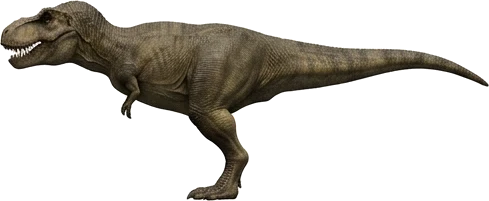 T. rex ('Sue')12.3 m length
Four Anatomical Differences Built for Opposite Climates
Placing these two proboscideans side by side in 3D showcases Allen's Rule—the biological law stating that warm-blooded mammals in polar climates evolve smaller exposed appendages to reduce heat loss, while tropical relatives evolve larger radiators:
- Ear Surface Area (6× Difference): An African bush elephant's fan-shaped ears grow up to 1.8 to 2.0 meters tall and carry dense capillary beds that dump excess savannah heat with every flap. Frozen Siberian carcasses confirm that woolly mammoth ears shrank to just 30 to 38 centimeters—small enough to stay shielded from frostbite at −40°C!
- Tail & Trunk Geometry: Woolly mammoth tails measured barely 35 to 50 centimeters (less than half an African elephant's ~1.0–1.3 m tail), and their trunks ended in a wider snow-grasping tip lined with insulating hair.
- Spiraling Snow-Sweep Tusks: Both sexes of Loxodonta africana and Mammuthus primigenius grew modified upper-incisor tusks, yet mammoth tusks curved outward, downward, and then back inward up to 2.5 to 3.5+ meters along the arc. Wear facets preserved on Arctic fossils prove mammoths swept their lower tusk curves horizontally across wind-packed snow crusts to expose dry steppe sedges and grasses beneath.
- High-Crowned Grazing Molars: Unlike African elephants, which mix tree bark, branches, and grass using diamond-ridged molars, woolly mammoths evolved flat, tightly packed lamellar tooth plates (up to 24–27 enamel ridges per molar) built like living millstones to grind gritty, silica-rich tundra grass.
Ready to calibrate elephants, mammoths, rhinos, moose, and dinosaurs purely by eye? Open African Elephant vs. Woolly Mammoth in 1:1 3D, play a 3-Heart Survival streak in Animal Size Comparison Game, or hide live meter readouts in Fermi Estimation Game.
Sources & Primary References
- Larramendi, A. (2016), Acta Palaeontologica Polonica 61(3): 537–574 — Shoulder Height, Body Mass, and Shape of Proboscideans
- Larramendi, A. (2016) Full Open-Access Monograph PDF — Acta Palaeontologica Polonica
- University of Michigan Museum of Zoology (ADW) — Loxodonta africana (African Bush Elephant)
- UC Museum of Paleontology (Berkeley) — The Elephantidae
- U.S. National Park Service (Bering Land Bridge) — The Bering Land Bridge & Pleistocene Ecosystem
- U.S. Fish & Wildlife Service ECOS — African Elephant (Loxodonta africana) Species Profile